Wednesday, June 24, 2015

Travelogue: On crowds, by a distinguished member thereof


It is no secret that many popular tourist destinations can be very crowded, especially in Italy.

We certainly found that to be the case, but I'm reluctant to complain too much about it because I was, after all, a member of the crowd myself.  It calls to mind an old Peanuts cartoon in which Lucy says something like, "Everybody says there're too many people, but nobody wants to leave."  That really gets to the heart of the matter.  How do I get rid of all these annoying crowds without eliminating myself in the bargain?

There is something heartening in the fact that crowds are trying to get in to see The Birth of Venus or the Sistine ceiling.  How would we feel if the churches and museums were almost  empty and catering only to the cognoscienti?  Or if the crowds were eliminated by charging admission at churches, or raising admission to put the great national collections out of the reach of the average tourist?  Yes, one can get annoyed at the occasional vulgar neighbor obviously and noisily checking one more famous painting off the bucket list.  But honestly, even those of us with refined tastes and the most exquisite sensibilities do pretty much the same thing.

I noticed, in the museums, that the "bunching" of spectators is exacerbated by two things, tour groups and audio tours.  Both tend to put people pretty consistently in front of the "war horses."  But tours and audio guides, however they may annoy those of us who don't think we need them, are surely part of that democratic notion that art should be available to people at all stages of education and appreciation.

I remember back in Boston, in the seventies, a local museum put on an exhibition of Chardin's genre paintings.  Even with a few college art courses, I wasn't much taken with what I knew of Chardin.  But a glowing review in the Boston Globe motivated me to take a look, and the audio guide really opened my eyes to much of what I missed or would never have considered on my own.

And there is also the fact that the bunching of crowds creates opportunities elsewhere.  I was genuinely disappointed by the crowd shown above, in front of Botticelli's Birth of Venus.  I was also disappointed by the fact that it was behind glass, a liability it shares with many uber-popular works that might be targets for the disturbed.  But on the opposite side of the room was an exquisite Botticelli Annunciation, alone and ignored by almost everyone.  I might have passed it by had the room been empty and I had been able to go right up and spend time with The Birth of Venus and Primavera.

So at times I joined the Crowd, straining to get close to those A-list cultural artifacts that are the object of this kind of tourism.  But I could also let the Crowd repel me toward those other items, honored and equally set apart, whose lack of "celebrity status" has nothing to do with their beauty or power to invoke the transcendent.


Monday, June 22, 2015

Teología y Liberación


When a new pope is chosen there is typically an exaggerated sense of impending change.  Most everyone is aware of some doctrine of the "infallibility of the pope."  Few know the purpose of that authority, or its limitations.  But perhaps for that reason, whenever a new pope is elected, there is much hope or fear among the half-informed that Catholic doctrine will be significantly changed--for the better or for the worse.

Pope Francis, like his immediate predecessors, has been subject to similar expectations, and like all popes he brings a new set of priorities and personal concerns to the office.  And his origins as a South American Jesuit have not surprisingly formed him with a particular concern for the Church's relationship to those whom political and economic oppression have left desperately poor.

This particular issue has long been associated with the something called "liberation theology." It's a term most of us think we know, and popularly it's most closely associated with South American politics, the murder of the Archbishop of San Salvador Oscar Romero, Marxism, and the critical reaction by the CDF during the early pontificate of Pope St. John Paul II.  Knowing just a little something about all of those, I thought I ought to learn a little more about it, so earlier this year I began reading what many consider the seminal work on the subject, Teología de la Liberación, first published in 1971 by the Peruvian Dominican priest Gustavo Gutiérrez.

Fr. Gutiérrez, unlike others associated with liberation theology, has never suffered any official censure for his work. It has been severely questioned on some points, something which I find less than alarming (see my third posting back on the dialectic between theology and authority in the Church).  But Fr. Gutiérrez has always had champions in the hierarchy, most recently and famously Gerhard Cardinal Müller, whom Pope Benedict put at the head of the CDF.

So, at this point I'm about a quarter of the way through Teología de la Liberación.  It begins with a review of what "theology" has meant in the Church, broadly identifying three types of theology:  "la teología como sabiduría," "la teología como saber rational," and "la teología como reflexión critíca sobre las praxis."   The first is the earliest form, theology as spiritual wisdom, arguably best personified in the Greek Fathers, but a continuing tradition exemplified in the West by works such as The Imitation of Christ.  The second type of theology is that which is characterized by rational analysis of the Christian revelation, a good example being the summas of St. Thomas Aquinas.

The third, critical reflection on practice, might seem to be novel, but Gutiérrez insists that it is a long-established form of theology, and points to St. Augustine's De civitate Dei as its most prominent exemplar:

La teología agustiniana de las histora, que encontramos en La ciudad de Dios, parte, por ejemplo, de un verdadero análisis de los signos de los tiemplos y de las exígencias que ellos plantean a la communidad cristiana.

So in this initial analysis we come, in the course of a brief history of social philosophy, to a few pages to the social analysis of Karl Marx.  His place here is not surprising; when Teología de la Liberación was written about a third of the world was governed by Marxist principles, and Marxism could look quite hopeful to those suffering under the violent autocracies of South America.  Marx was and remains almost unmentionable in North America (a patriotic by-product of the cold war), and from 1978 to 2008 the papacy was held by a man for whom Marxism was itself an oppressive dogma imposed by a foreign and hostile imperial power  (on the other hand, he entered the conclave that elected him pope reading Marx).  In this early discussion Gutiérrez puts Marx in the context of European social philosophy and the attempts to make history a genuine science.  Despite charges and suspicions, there is nothing remotely "Marxist" in Gutiérrez's historical review here. 

But as politics comes increasingly to the fore, there is an interesting follow-up to the appeal to St. Augustine noted above for the pedigree of this type of theology in a critique of the notion that the Church and the world co-exist on different planes--in other words there is a challenge to the Augustinian distinction between the City of Man and the City of God, intersecting but essentially distinct.   In  critically examining the notion of the Church's independence from politics, Gutiérrez notes how, in practice the Church has too often been not only political, but political in the sense of propping up an oppressive status quo.

In some ways this appeal reflects the more hopeful stance of the late sixties and early seventies.  There is an appeal to Bonhoeffer's assertion of a mündig gewordnende Welt, a world come of age.  For myself, however much I admire Bonhoeffer, this conception takes far too much for granted.  The "adulthood" of man has been asserted before (Kant's famous definition of enlightenment, for example, which Gutiérrez in fact cites earlier).  Bonhoeffer seems to ground his concept in the notion of the increasing explanatory power of science, a notion that seems naive in a world where the limitation of scientific explanation is increasingly obvious.  I've always countered the idea with a joke that was once making the rounds, i.e., that in every generation the civilized world is invaded by barbarians (whom we call children).

However old the world gets, few of us, individually, are going to get much more than our threescore and ten.  Each and every one of us starts from scratch.  Our elders and betters do their very best to impart the wisdom of the ages, and some of it undoubtedly sticks.  There is continuity and inertia in the institutions and foundations set up to last.  But we newbies will be afflicted by the same vices that afflicted our forebears, and commit the same mistakes, and succumb to the same temptations.  So we may, perhaps, die old and full of years and wisdom, but I'm not sure the world does.

I'll apologize for that lengthy digression, but it's not entirely inapplicable.  There a lot of this "New World Coming!" in the early Erasmus.  It's noticeably absent in the elder.  There seems considerable optimism in these early pages of Teología de la Liberación that the Church's weight can decisively tip the political scale toward the poor.  One can indeed still hope and advocate for that, while noting that the social and political weight of the Church has dropped off markedly in the last forty years.

I will try to return with further thoughts as I make may way through.

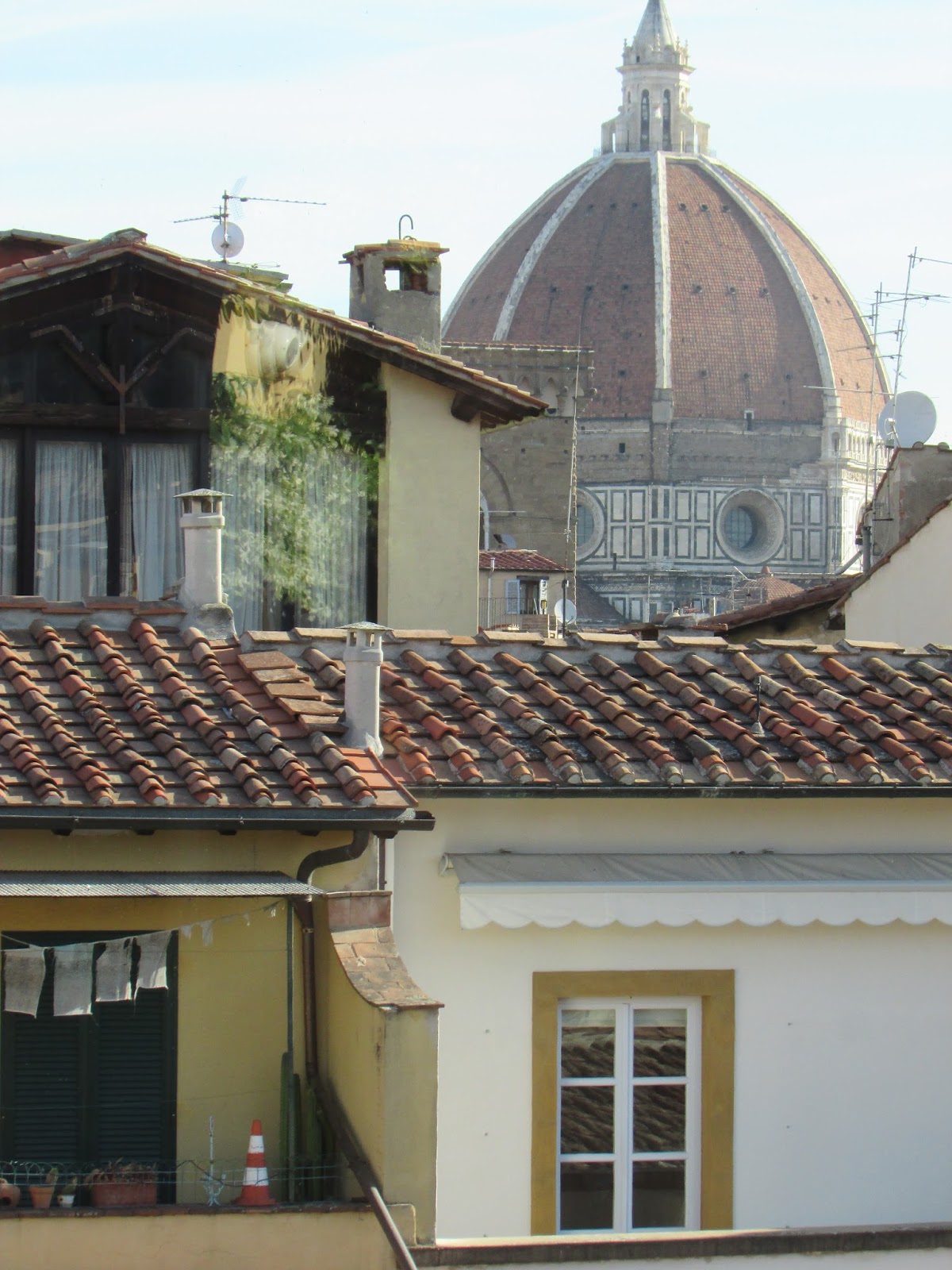
Travelogue


Part of the reason for the "hiatus" was a few weeks of traveling.

As you can probably guess from the photo, it included a couple of days in Italy.

In returning to active (if relatively infrequent) blogging I hope to put down a few thoughts that the trip raised, and will identify them under the rubric, "Travelogue."

Saturday, April 18, 2015

Hiatus

Is that the word?  I think so.

It was almost exactly a year ago that I said I'd try to post here every couple of weeks, and I've mostly been able to keep that up--without, I hope, appearing to talk for the sake of talking.

It looks like a very busy time is coming up, so I've decided to stop posting here till mid-summer or so.  Hope the "happy few" will be looking in again then when I hope to have a little more leisure.


Wednesday, March 25, 2015

Grundkurs & Catechismus

Having just completed Rahner's Grundkurs des Glaubens I think it appropriate to make a few closing comments.  Earlier posts can be found on April 12 and November 9 of last year.

After finishing the book I remembered that I had actually owned a copy of the English translation, Foundations of Christian Faith, in the late 1980's, but that, for whatever reason, I never started it and in fact eventually gave it away.  I also acquired, some few years later, a Rahner anthology (I think it was called A Rahner Reader) which I occasionally picked up, but which I got very little out of and also gave away.  I'm a little puzzled myself about why I now find compelling what I first found simply daunting, then pedestrian.

The closing substantive sections of the book cover Church, Christian life, and eschatology.  I think it goes too far to call them "conventional."  I myself didn't enter the Catholic Church until after the book was first published in the late 1970's, and Rahner's influence in the Church had long been felt (if rather controversially) since the convening of the council.  Perhaps it's more accurate to say that the latter part of the book largely presupposes the grand ambition inherent in the earlier chapters' development of human transcendence and its subsequent link with the self-mediation of God in history.

Surely thousands of theological books have been published over the last half century.  Rahner's Grundkurs, though, has credibly been claimed as the great Catholic Summa of the twentieth century; that is, a work that tries to integrate post-Cartesian European philosophy--up to and including the ontology of Martin Heidegger--with the Catholic faith, in the same way that St. Thomas Aquinas integrated the newly-revived philosophy of Aristotle. 

Respecting that goal it seems to me that it achieves a high level of success.  And, as an old philosophy major, I found it a very rewarding and provocative re-statement of the claims and core of the Catholic faith.

On the other hand, when I look out into contemporary popular culture, I don't see a lot of anxiety about keeping the faith current with Heidegger.  Even "existentialism," a term that still excited my generation, has become old hat, a matter for history, not concern and engagement.  What matters now is sexual ethics.  That's what's dividing ancient communions, causing the shouting matches, marching forward or backward in churches, legislatures, and courts.  Next to Sex, Existence has lost its luster.  Everything in time ages.

In the last, brief section, Rahner unexpectedly takes up the subject of concise statements of faith, citing the Apostle's Creed as the prime example, and asks whether, and how, the material he has developed could go into such a statement.  He detours into the question of a catechism, and concludes that such a thing would be fruitless because of the plurality of cultures among which the contemporary Church lives, and ends by concisely restating what he considers his fundamental assertion, under three different aspects, which he finally, neatly, correlates to the persons of the Trinity.

Now what I find interesting about this conclusion is the middle part, the skepticism about the possibility of a catechism.  In fact, as is well known, a universal catechism was published roughly ten years after Rahner's death, the original French text in 1992, the final, official Latin version in 1997.  Rahner was right that it couldn't be concise; the Latin version runs a few hundred pages longer than Grundkurs des Glaubens.

The Catechism, the first to come out of Rome since the Counter-Reformation, is not simply a compendium of doctrine and ethics.  It is not a treatise, an argument, a systematic development of ideas, as Grundkurs is, but it's not without its rhetorical aspect; the very organization suggests a systematic whole, beginning with a mutual seeking, man for God, God for man.

So in some sense, the two volumes provide a suitable epitome of late 20th century Catholicism, first through the eyes of the critical philosophical theologian, then as the careful exposition of the curial magister.

I often think that the actual function of magisterial authority in the Catholic Church is misunderstood.  For me it's well-described by a slogan I first came across in freshman Economics, as applied to regulating the money supply:  The better your brakes, the faster you can drive your car.

I see the perennial conflict between theologians and bishops as one of the strengths of the whole structure.  The Church has excellent brakes, and those brakes, Dottrina Fide primarily, in the eyes of outsiders, make the institution appear oppressive.  But that, I think, is what allows thinkers like Rahner to flourish.  It's not a comfortable place to be, and I need not list the other names, fairly well known, of those who left rather than remain subject to magisterial supervision.

Still, I admire a John Courtney Murray, who was silenced for a considerable period, but who provided the foundation for a revolution in Church/State and ecumenical relations in the decrees of Vatican II that took up where he left off.  Even more can I admire someone like Pierre Teillard de Chardin, who was never allowed to publish his theological reflections in his lifetime, but remained obedient, became rather wildly popular after his death, and whose work has even been praised (if guardedly) by former Pope Benedict XVI.  For myself I have many doubts and questions about the work of Teillard de Chardin, but in some ways I see that the "brakes" of the magisterium allowed his "wild surmise" to develop, sub silentio, and bear fruit over a longer period of time than any individual's natural desire for success, fame and recognition might allow.

But yes, I digress.  As to Grundkus and the Catechismus, I think we can prize them, together, as a dialectic of "pushing the envelope" and "protecting the envelope," so that it still conveys the message the Church was founded to proclaim.  The first without the second might consume itself; the second without the first would petrify.


Tuesday, March 10, 2015

Pericles' Funeral Oration, paragraph 3

Χρώμεθα γὰρ πολιτείᾳ οὐ ζηλούσῃ τοὺς τῶν πέλας νόμους, παράδειγμα δὲ μᾶλλον αὐτοὶ ὄντες τισὶν ἢ μιμούμενοι ἑτέρους. καὶ ὄνομα μὲν διὰ τὸ μὴ ἐς ὀλίγους ἀλλ' ἐς πλείονας οἰκεῖν δημοκρατία κέκληται· μέτεστι δὲ κατὰ μὲν τοὺς νόμους πρὸς τὰ ἴδια διάφορα πᾶσι τὸ ἴσον, κατὰ δὲ τὴν ἀξίωσιν, ὡς ἕκαστος ἔν τῳ εὐδοκιμεῖ, οὐκ ἀπὸ μέρους τὸ πλέον ἐς τὰ κοινὰ ἢ ἀπ' ἀρετῆς προτιμᾶται, οὐδ' αὖ κατὰ πενίαν, ἔχων γέ τι ἀγαθὸν δρᾶσαι τὴν πόλιν, ἀξιώματος ἀφανείᾳ κεκώλυται. ἐλευθέρως δὲ τά τε πρὸς τὸ κοινὸν πολιτεύομεν καὶ ἐς τὴν πρὸς ἀλλήλους τῶν καθ' ἡμέραν ἐπιτηδευμάτων ὑποψίαν, οὐ δι' ὀργῆς τὸν πέλας, εἰ καθ' ἡδονήν τι δρᾷ, ἔχοντες, οὐδὲ ἀζημίους μέν, λυπηρὰς δὲ τῇ ὄψει ἀχθηδόνας προστιθέμενοι. ἀνεπαχθῶς δὲ τὰ ἴδια προσομιλοῦντες τὰ δημόσια διὰ δέος μάλιστα οὐ παρανομοῦμεν, τῶν τε αἰεὶ ἐν ἀρχῇ ὄντων ἀκροάσει καὶ τῶν νόμων, καὶ μάλιστα αὐτῶν ὅσοι τε ἐπ' ὠφελίᾳ τῶν ἀδικουμένων κεῖνται καὶ ὅσοι ἄγραφοι ὄντες αἰσχύνην ὁμολογουμένην φέρουσιν.

"Our constitution does not copy the laws of neighbouring states; we are rather a pattern to others than imitators ourselves. Its administration favours the many instead of the few; this is why it is called a democracy. If we look to the laws, they afford equal justice to all in their private differences; if no social standing, advancement in public life falls to reputation for capacity, class considerations not being allowed to interfere with merit; nor again does poverty bar the way, if a man is able to serve the state, he is not hindered by the obscurity of his condition. The freedom which we enjoy in our government extends also to our ordinary life. There, far from exercising a jealous surveillance over each other, we do not feel called upon to be angry with our neighbour for doing what he likes, or even to indulge in those injurious looks which cannot fail to be offensive, although they inflict no positive penalty. But all this ease in our private relations does not make us lawless as citizens. Against this fear is our chief safeguard, teaching us to obey the magistrates and the laws, particularly such as regard the protection of the injured, whether they are actually on the statute book, or belong to that code which, although unwritten, yet cannot be broken without acknowledged disgrace."

This passage introduces us to the idea of Athenian "democracy," not as "rule of the people, " which I suppose would be "demarchy," but "power (or force ) of the people," because it is "for" ("ἐς'') the many rather than the few.  It boasts of an equality of opportunity in public life that is claimed absolutely, but which we would immediately discount because of the exclusion of slaves and women (the exclusion of foreigners and children from public life we still pretty much observe).  It is, in short, more directly participatory than our own "democracy," but with a considerably smaller percentage of the population participating.

There is also the assertion that this social equality in government ("πρὸς τὸ κοινὸν ," "regarding the common") also applies to ordinary life, ("ἐς τὴν πρὸς ἀλλήλους τῶν καθ' ἡμέραν ἐπιτηδευμάτων,"daily pursuits with respect to each other").  This freedom may be offensive, but it isn't lawless, for two reasons:  first, because of the legal protection against injury, and second, because of the disgrace attending the breaking of unwritten codes.

When we think of the legal protection against injury we immediately think of our own system, whereby civil wrongs, or torts, are redressed, for bodily injury, or injury to reputation.  The Greek notion is probably a little broader.  The phrase used, "ὅσοι τε ἐπ' ὠφελίᾳ τῶν ἀδικουμένων κεῖνται ," "whatever is owed as a result of injustice," has a rather broader meaning than we would normally expect, I think.  To take one example, from Douglas MacDowell's The Law in Classical Athens, there was a legal penalty for the commission of hybris, which is "indulging in conduct which is bad, or at best useless, because it is what he wants to do, having no regard for the wishes or rights of other people,"--in other words, in misusing energy or power self-indulgently.  Now admittedly the evidence MacDowell cites is later than the Age of Pericles--from Aristotle and Demosthenes.  But I think that it illustrates the often-overlooked differences between the freedom (and indifference) of our mass societies and the considerably greater expected social conformity of smaller, self-contained communities like Athens.  Plainly Plato, who associated the execution of Socrates with Athenian democratic tendencies, didn't find the Periclean balance satisfactory. 


Saturday, March 7, 2015

Daniel Auteuil's Marcel Pagnol


I didn't know Marcel Pagnol by name until last year, though I had seen a couple of film adaptations of his work in the eighties--"Jean de Florette" and "Manon of the Spring."  Lately, having picked up an interest in Provence, I have taken a more particular interest in his work.

Pagnol's life coincided with the first three quarters of the last century.  His stories are set in Provence in the time of his childhood, in Marseilles, or inland, among the dry hills.  He was a playwright, novelist and filmmaker, though I've neither seen his own films, nor read any of his written work.  I therefore know him only through more contemporary film adaptations, the above-mentioned "Jean de Florette" and "Manon of the Spring," as well as "My Father's Glory," "My Mother's Castle," "The Well-Digger's Daughter," "Marius" and "Fanny."  

I understand that he is not so popular as he once was.  No existentialist, or nihilist, or structuralist, his work mostly celebrates the working peasantry and the petty bourgeoisie.  It's not all sunny, of course.  The heartbreaking "Jean de Florette" reveals just how very cruel a peasant maliciousness can be (comp. Hugo's mauvais pauvre).  But his plots typically follow the usual conventions of romantic melodrama:  infatuation, obstacles, dilemmas, and resolution, not always satisfactory.

Not too long ago I was re-watching "The Graduate," and was a little taken aback (as I shouldn't have been) by the fact that suddenly, it seemed, I was identifying, not with Benjamin, but with his parents (but not, I hope, with Elaine's).  Romance has a different cast from the parental perspective, and that's part of what struck me about these films.

Daniel Auteuil directed the three most recently-made films, "The Well-Digger's Daughter," "Marius," and "Fanny."  In all three films he also plays the widowed father of one of the romantic leads--the father of Patricia in "The Well-Digger's Daughter," the father of Marius in "Marius" and "Fanny."  Perhaps it was because he was directing himself, or perhaps it was because of my own age and role, but in all three films there was a pronounced sense of the joys, and fears, and conflicting demands on the paterfamilias--the urge to protect children (even those who have left childhood), the need to let them pursue their own separate ambitions, the vicarious happiness of anticipating their happiness, and the memory of one's own navigation of the uncertain waters of youth.

These stories are set in a conventionally-simpler time, in a setting that many would find idyllic--the landscapes of Provence, the Mediterranean seascape of Marseilles.  They have been mediated to us by Cezanne and Van Gogh, and arguably rendered irresistibly picturesque by the likes of Peter Mayle.  But the characters are real, and upon their actions and decisions hang happiness or misery, however quaint the setting or breathtaking the cinematography.

And the society is more traditional, more provincial, probably more patriarchal than our own.  But I don't have the problem with tradition that many have, and, far from seeing patriarchy as a thing evil in itself, I tend (as a pater myself) to see patriarchy as a power coupled with a responsibility, a kind and protective thing when used rightly, though unimaginably destructive when abused, or abusing.  One of the unexpected revelations in "Fanny" is the discovery that the old man who offers to marry her, whom we naturally imagine an old lecher, turns out to be motivated, himself, by a paternal instinct:  though a "rich man" in his own circle, he is sad and disappointed that he has no child himself.

 Pagnol in fact followed up "Fanny" with a third story, "César," the name of Auteuil's character, Marius' father.  Auteuil is supposed to have it in the works.  I will be looking for it.